

INWED 2026 – Engineering Intelligence: Q&A
Every year on the 23rd of June, International Women in Engineering Day (INWED) celebrates the outstanding achievements of women engineers around the world and shines a spotlight on the opportunities engineering creates for future generations.
This year’s theme is Engineering Intelligence
Engineering Intelligence is what keeps our world moving. It’s the expertise, creativity, and judgement behind the systems, structures, and solutions we depend on every day. It’s human skill, technical understanding, cultural leadership, and the talent pipeline that will carry us into the future.
Women contribute to every part of this intelligence through design, leadership, and innovation, but their work is still too often overlooked. This INWED, we’re putting that work, and the women behind it, in the spotlight.
Last week, we sat down with three of our brilliant women engineers to conduct a short Q&A focused on their Engineering Intelligence, and how they hope to inspire a future generation of women in engineering.
Here’s what they had to say.
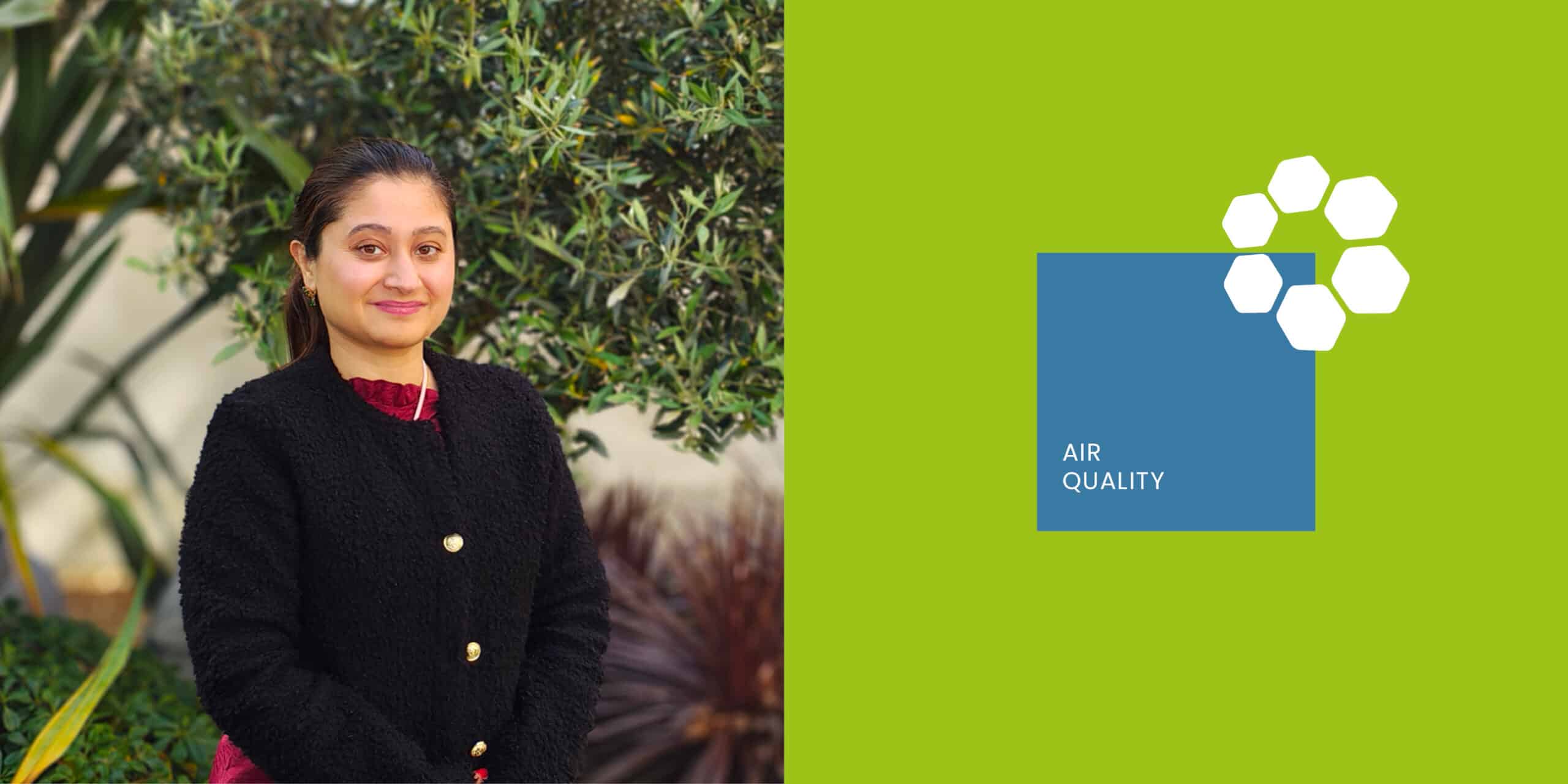
Dr Saba Manzoor – Technical Director (Air Quality)
Q: Air quality is invisible until it isn’t. How does Engineering Intelligence help you make an unseen risk real to the people who need to act on it?
A: Engineering Intelligence bridges the gap between raw data and human perception by turning data into actionable insights. We use advanced dispersion modelling, spatial mapping, and real-time sensor networks to essentially “paint” the air.
When a developer or policymaker sees a heat map showing exactly how traffic emissions loop back into a proposed school playground, or how a building’s geometry traps pollutants, the risk is no longer invisible – it’s undeniable. Engineering Intelligence allows us to present predictive scenarios (e.g., “If we modify this layout, pollution drops by 30%”) which shifts the conversation from a compliance box-ticking exercise to an active, visual design tool that stakeholders can immediately grasp and act upon.
Q: What’s a moment in your career when your analysis directly changed a decision – e.g. a planning condition, a design change, a policy?
A: I was leading the Air Quality Assessment for the TAPI (Turkmenistan–Afghanistan–Pakistan–India) gas pipeline project, which was funded by the Asian Development Bank. The scope involved evaluating the construction and operational emissions across a massive trans-boundary corridor. Our dispersion modelling revealed a critical issue: the proposed pipeline routing and its associated above ground substations were positioned in a way that would cause localised air quality impacts – specifically nitrogen dioxide (NO2) and particulate matter – to vastly exceed World Health Organization (WHO) ambient air quality standards at the nearest human receptors. I presented these findings directly to the project consortium and the bank’s environmental safeguards team. Because the data clearly showed a severe health risk to nearby settlements in rural Pakistan and Afghanistan, the engineering team agreed to a major design update. They officially rerouted sections of the pipeline and relocated key emissions-heavy infrastructure further away from populated areas to ensure compliance with WHO guidelines, directly protecting the long-term health of those vulnerable communities.
Q: What would you tell a woman considering a career in air quality or environmental consultancy?
A: Your voice and your perspective are desperately needed in this space. Climate change and air pollution do not affect everyone equally, and solving these complex environmental challenges requires diverse problem-solvers.
Environmental consultancy is a rapidly growing field where technical rigour meets social impact. If you enjoy blending data science, chemistry, and fluid dynamics with urban planning and public health, it is incredibly fulfilling.
My biggest advice would be to build your technical foundation early and get comfortable with coding, GIS, and modelling tools. Just never lose sight of your communication skills whilst doing so! The most successful consultants aren’t just the ones who run the best models; they are the ones who can walk into a boardroom or a town hall and clearly explain why the science matters. Find female mentors in the industry, ask questions boldly, and know that you have the agency to literally shape the environments people live in.

Grace Beard – Flood Risk Consultant
Q: Flood risk modelling means making decisions today based on judgement about conditions decades from now. How do you build confidence in that kind of forward-looking intelligence?
A: Flood risk modelling is about combining the best available data, robust science, and professional judgement to understand future risks. Over my five years as a consultant, I’ve learned that confidence comes from testing multiple scenarios rather than relying on a single prediction. We draw on climate projections, historical flood records, and hydraulic modelling to build a range of plausible outcomes, and we are honest in our reporting about where the evidence is strong and where we are making assumptions. We can’t predict the future with certainty, but we can provide evidence-based assessments – and designs flexible enough to adapt – that help communities, developers, and decision-makers make informed, resilient choices for the decades ahead.
Q: How is a changing climate changing the nature of the judgement calls you have to make?
A: Climate change is increasing both the uncertainty and the urgency of our work. We’re seeing more frequent extreme rainfall events and growing pressure on existing drainage and flood defence systems, and the guidance itself keeps shifting as projections are revised. So, the judgement calls are increasingly about resilience and adaptability, rather than simple compliance. Instead of designing only to meet today’s standards, we’re asking how a scheme performs under future scenarios and whether it can be adapted later as conditions evolve. It takes a more forward-thinking approach, clearer conversations with clients about what the uncertainty actually means for their decisions, and a willingness to balance current needs against long-term risk.
Q: What would you tell a woman considering a career in flood risk or water engineering?
A: I would genuinely encourage her to go for it. When I started out in the field, I don’t think I fully appreciated how much of the job would be about people as much as it is about modelling and data. Since joining Create, I’ve worked on projects where our work directly shapes how communities are protected from flooding, and that’s something I find really grounding.
It’s a career that constantly pushes me to think in different ways – one day I’m deep in technical analysis, the next I’m explaining risks to stakeholders who don’t have a technical background. That mix of problem-solving, communication, and real-world impact is what has kept me in the field and made it so rewarding.
There have definitely been challenges, especially early on in building confidence and finding my voice in technical discussions, but those experiences have also been incredibly valuable for my growth. I’ve also been encouraged by seeing more women entering the industry and being supported by strong networks of mentors and colleagues who genuinely want to see you succeed. I would also encourage attending networking events, as they’re a great way to meet like-minded people and build confidence in the industry. Overall, it’s become a career where I feel both challenged and proud of the contribution I’m making.

Bomi Ogunade – Associate Director (MEP Building Services)
Q: The systems you design must work safely, and every time. How does that shape the kind of judgement you bring to your work?
A: The fact that these systems must work safely, every time, makes me very deliberate in my decision-making. I approach designs with a strong focus on risk, compliance, reliability and long-term performance, always considering how systems will operate in both normal and fault conditions.
It also means I don’t make assumptions. I rely on technical evidence, challenge potential issues early, and collaborate with others when needed to ensure the best outcome. As a Building Services Engineer, I understand that the decisions I make directly impact people’s safety and wellbeing, so I bring a high level of accountability, attention to detail and professional judgement to every project.
Q: What’s a piece of work you’ve delivered that the public will never see, but that everything else depends on?
A: One example would be the coordination and design of building services infrastructure within ceiling voids and plant spaces. The public will never see the ventilation ductwork, pipework, containment systems or plantroom layouts I helped design, but the entire building depends on them functioning correctly.
On one project, I was responsible for coordinating services within a highly constrained ceiling space to ensure all systems could be installed, maintained and operated safely. It required balancing technical requirements, collaboration with other disciplines and resolving clashes before construction.
Most people using the building will never know that work was done, but it directly affects the building’s comfort, safety, energy performance and day-to-day operation. I find a lot of satisfaction in delivering that kind of work because, while it’s largely invisible, it’s fundamental to the success of the project.
Q: What would you tell a woman considering a career in Building Services engineering?
A: I would encourage her to go for it. Building Services engineering is a rewarding career where you can make a real impact on how buildings perform, how people experience them, and how we tackle challenges such as sustainability and Net Zero.
When I started my career, there were fewer women in the profession, and there were times when I was the only woman in the room. However, I found that engineering is ultimately about knowledge, problem-solving and teamwork. As I gained experience and confidence, I realised that my perspective and contributions were just as valuable as anyone else’s.
My advice would be to be confident in your abilities, stay curious, ask questions, and seek out mentors and role models. Don’t let the fact that the industry has traditionally been male-dominated put you off. The profession is becoming more diverse, and there is a real opportunity for women to help shape the future of the built environment. It’s a career where your work has a lasting impact, and that’s something to be proud of.